Inside the Brain of the Default Parent
The default parent isn't just busy they carry the full picture of family life at all times. Research confirms what so many parents already feel: this load is real, it's boundaryless, and it doesn't go away when you leave the house.
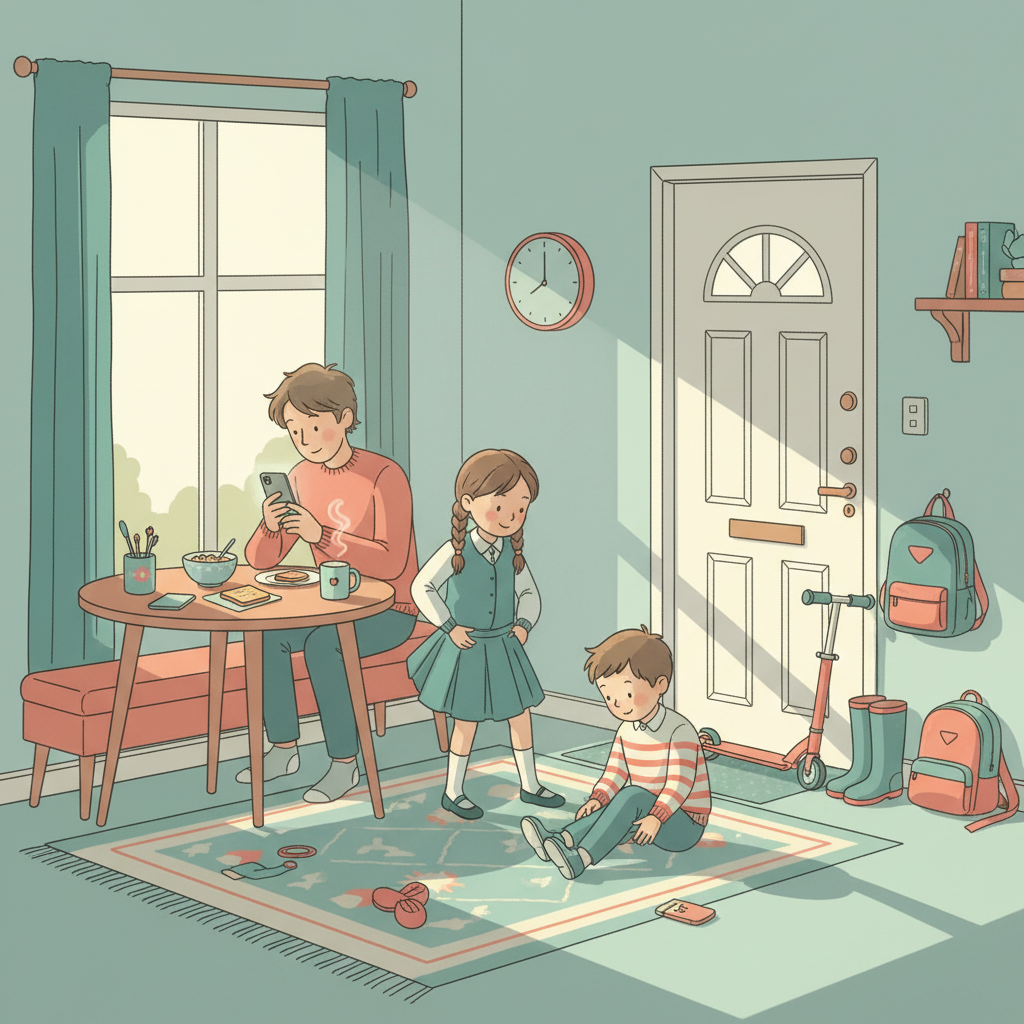
It's 7.23am. You're making packed lunches, mentally running through the week ahead, and simultaneously trying to remember whether the non-uniform day is this Friday or next. You haven't looked it up yet because you're already holding three other things in your head at the same time.
If this sounds familiar, you are probably the default parent.
The default parent is not a formal title. It's the person in the household who carries the full picture not just individual tasks, but the ongoing responsibility for knowing what needs doing, when, for whom, and whether it's been done. It is exhausting in a way that is very hard to explain to someone who isn't carrying it.
What the research says about mothers and primary caregivers
Research consistently shows that mothers carry out the majority of daily cognitive household tasks tracking children's schedules, managing school communications, planning meals, maintaining a running mental inventory of what the household needs. Crucially, this doesn't change meaningfully when mothers are the primary earner. The cognitive load follows the person, not the payslip.
The specific frustration that comes up again and again in qualitative research is this: even when a partner genuinely helps with physical tasks, the responsibility for knowing what needs doing still sits with one person. Doing the task when asked is different from owning the task. The ownership that constant background awareness is the load.
University of Bath research published in 2025 found that even highly successful career women are carrying the majority of the mental load at home, in households where both partners would describe themselves as sharing responsibilities fairly.
It follows you everywhere
What makes the default parent experience distinct is that it doesn't stop when you leave the house. A systematic review of mental labour by Reich-Stiebert, Froehlich and Voltmer (2023) found that women are significantly more likely than men to take on the anticipatory and coordinating roles the parts of the mental load that are always running in the background, not tied to any specific moment.
Researchers describe this labour as boundaryless. It is present in the school playground, during a work meeting, at a social event. There is rarely a moment when the mental register of what-needs-to-be-done-and-by-whom is fully switched off.
You're not imagining it, and you're not alone
In Planily's pre-launch pilot survey, 93% of respondents said household coordination falls predominantly on one partner. Of those, 64% reported experiencing moderate overwhelm or higher. These are people who had already sought out a coordination tool which means the numbers almost certainly understate the picture across the broader population.
None of this means the other partner isn't trying. The research is clear on that point: in most households, the issue isn't absence or indifference. It's visibility. The supporting partner genuinely doesn't have the same picture of what's being managed. They can't help share something they can't see.
What actually helps
The research from Mansfield and Henderson (2025) found that when domestic and financial responsibilities are more evenly distributed, individuals are significantly less likely to experience overwhelming pressure. The converse is equally true: when load is concentrated in one person, stress increases and wellbeing suffers.
What helps is not asking your partner to do more. It's giving them a genuine view of the full picture so that both of you can see what's there, who's responsible for what, and what's coming next.
That's what Planily is designed to do: make the invisible visible, so the load can be shared rather than just carried.
Ready to share the load?
Planily is designed for real UK families. Join the pilot and see the difference.
Apply for the Pilot